One World Projects
Upcycled Metal Ornaments
Upcycled Metal Ornaments
Couldn't load pickup availability
These metal ornaments make a wonderful decoration for Christmas or any time of the year.
- Angel Ornament measures 3-1/8" high x 2-1/2" wide
- Birds Ornaments measure
- Elephant Ornament measures 3-1/2" high x 4-1/4" wide
- Heart Ornament measures 4" high x 4" wide
- Hummingbird Ornament measures 3-1/2" high x 3-1/8" wide
- Moon Ornament measures 4-1/4" high x 4" wide
- Nativity Ornament measures 4-1/4" high x 4" wide
- Paw Ornament measures 2-3/4" high x 3-1/4" wide
Handmade in Haiti and fair trade imported.
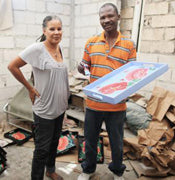
Haiti is known worldwide for its unique steel drum art. Artisans collect these salvaged industrial drums to create beuatiful pieces of art.The artist first removes both round ends of the drum and fills the cylinder with straw and dried banana or sugar cane leaves. He sets it on fire, to burn off any paint or residues inside the cylinder. After the metal cools down, it is cut and flattened into a "metal canvas".
With chalk, the design is drawn onto the metal sheet. Using hammer, chisel and various other basic tools, the metal is given shape and several decorative patterns are embossed onto the metal, creating a unique and treasured piece of recycled art. The artisans' creativity is inspired by themes familiar to their island life, including the sea and religion. Colors, coats and finishes are applied to the embossed metal, finally the piece is signed off by the artisan.

This particular art form was born in Haiti in the early 1950's by a simple blacksmith, Georges Liautaud. In his small shop, he made and repaired tools and created metal crosses for the graves in the Croix-des-Bouquets cemetery. It was at the encouragement of an American teacher, DeWitt Peters, who in 1944 opened the Le Centre d'Art in Port-au-Prince, that Georges Liautaud expanded into the creation of decorative metal sculptures. A few talented men apprenticed under him, and this tradition has continued. A particular metal artist will have assistants, who, as they mature in the art, will branch out and begin expressing themselves with their own designs. In the recent years, metal drums are being replaced by plastic drums, and the availability of metal scrap for these beautiful artworks is dimishing.
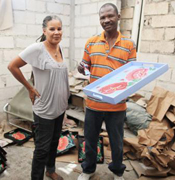 Haiti is often considered the poorest nation in the Western Hemisphere. Haitian artisans live in a country where the political climate and hardships imposed by economic embargos and sanctions in the 1990's have contributed to poverty and accelerated environmental degradation. Health care and education are unobtainable dreams for the impoverished 75-80% majority. The average income is $55. per month. Only 40% of the population has access to potable drinking water and 25% have access to sanitary sewage systems. Infant mortality is over 7%, malnutrition is a common ailment, and almost half of the population is illiterate.
Despite this adversity there is hope. The Artisan Business Network (ABN) empowers Haitians with entrepreneurial tools, design input, and market access. The ABN is making essential improvements the earnings or artisans, helping them to provide for their families and community wellbeing through commerce based in Haiti's profound artisanal culture.
ABN strives to empower Haiti’s artisan culture in order to improve community well-being. They have three depots located in Jacmel, Port-au-Prince and Croix-des-Bouquets and support the traditional arts in several mediums including: metal crafts, soapstone, paper mache, and plant fibers.
Talented Haitians are ready and eager to recapture the losses brought about by the economic trade embargo of the 1990's, subsequent internal political deadlock, and the devastation of the January 2010 earthquake. Because of the efforts of ABN, and their ability to connect artisan handcrafts with the international market, many artisans are now able to better care for themselves and their families.
About the Artisans
About the Artisans
Chichicastenango, Guatemala, has become one of the most important heritage centers in Guatemala during the past 10 years, due to its predominant indigenous Maya Quiche population and their traditional textile products. Yet, despite increased tourism and a renewed interest in traditional Mayan crafts, work opportunities remain few for the indigenous population, many of whom are uneducated and otherwise unemployable.
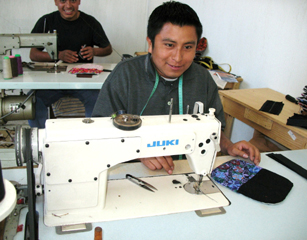 Enter De Colores Art, a local business that levels the playing field for villagers by offering free training to anyone who demonstrates the initiative to learn a trade. The company employs 30 women and 18 men to knit and embroider textile products, with the option of working at home using materials provided by the company. De Colores recognizes the culture of its Mayan employees, and as such allows flexible hours and gives time off for sowing and harvest days.
De Colores also invests in community education projects by funding two local schools in the neighboring towns of Chujupen y Pachoj, and by providing scholarships to qualifying students.
In addition to stimulating the local economy by creating new jobs, De Colores makes a conscious effort to use recycled materials whenever possible. The reason for this is twofold: to preserve Mayan culture, as recycled textiles showcase traditional knitting patterns that aren’t often seen in newer textiles, and to reduce scraps and waste.
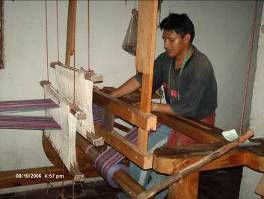
Communities collaborate in the production process, as men work on the biggest textiles and women do the embroidery, crochet and macramé seen in smaller pieces. In some cases, in order to be competitive, sewing machines are used to assemble the finished product, although all the components are handmade and hand embroidered from cotton, wool and/or silk.