

OWP
Hand-Carved One World United Gourd Ornament-Hand-Painted -Fair Trade-Peru
Hand-Carved One World United Gourd Ornament-Hand-Painted -Fair Trade-Peru
Couldn't load pickup availability
This wonderful gourd ornament with people joining hands represents how all in this world are truly a part of a global family and that when we reach out in love and peace, then together we can help and care for each other and resolve not only the problems of individuals, families, and communities but solve many of our global problems like the environment, health care, education, poverty, women's and children's rights, world peace and more. Put it on your tree or hang it in your home as a reminder of how we are all part of the same family.
Gourds are also a natural and uniquely shaped vegetable, similar to a pumpkin or squash. As such, designs, shapes, and dimensions will vary slightly.
- Measures approximately 2-1/2” high x 2-3/4” diameter
Handmade, carved, and etched by artisans in Peru and fair trade imported.
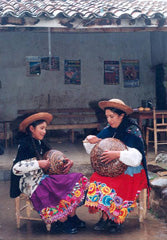
Peruvian artisans have practiced the art of gourd-carving for more than 4,500 years, transforming a simple squash into intricately designed bowls, boxes, windchimes, birdhouses, purses, vases, and other bits of home decor. The twin villages of Cochas Grande and Cochas Chico, where our artisans Raquel and Esperanza live, work, and run gourd-carving workshops to create local jobs, are the center of this ancient art.
To learn more about the artists who create these eco-friendly ornaments and the techniques they use, please read our extended description under "About the Artisans".
About the Artisans
About the Artisans
Chichicastenango, Guatemala, has become one of the most important heritage centers in Guatemala during the past 10 years, due to its predominant indigenous Maya Quiche population and their traditional textile products. Yet, despite increased tourism and a renewed interest in traditional Mayan crafts, work opportunities remain few for the indigenous population, many of whom are uneducated and otherwise unemployable.
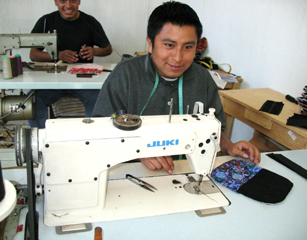 Enter De Colores Art, a local business that levels the playing field for villagers by offering free training to anyone who demonstrates the initiative to learn a trade. The company employs 30 women and 18 men to knit and embroider textile products, with the option of working at home using materials provided by the company. De Colores recognizes the culture of its Mayan employees, and as such allows flexible hours and gives time off for sowing and harvest days.
De Colores also invests in community education projects by funding two local schools in the neighboring towns of Chujupen y Pachoj, and by providing scholarships to qualifying students.
In addition to stimulating the local economy by creating new jobs, De Colores makes a conscious effort to use recycled materials whenever possible. The reason for this is twofold: to preserve Mayan culture, as recycled textiles showcase traditional knitting patterns that aren’t often seen in newer textiles, and to reduce scraps and waste.
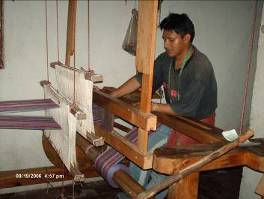
Communities collaborate in the production process, as men work on the biggest textiles and women do the embroidery, crochet and macramé seen in smaller pieces. In some cases, in order to be competitive, sewing machines are used to assemble the finished product, although all the components are handmade and hand embroidered from cotton, wool and/or silk.