

One World Projects
Gourd & Ceramic Ladybug Ornament
Gourd & Ceramic Ladybug Ornament
Couldn't load pickup availability
Ladybugs almost always equate to having good fortune, happiness, innocence, and true love. This unique hand-carved gourd Ladybug ornament makes both a great gift at time of the year and is a wonderful home accent. This gourd ornament is a 3 dimensional Lady Bug w/ ceramic accents. Hang them on your tree, in the window, or set on a mantel these ornaments are a beautiful way to help provide for artisans and their families.
Gourds are a natural and uniquely shaped vegetable, similar to a pumpkin or a squash. As such, designs, shape and dimensions will vary slightly.
- Height measures approximately 2-3/4"
- Diameter measures approximately 2-1/2"
These ornaments are hand-carved in Peru and Fair Trade imported.
Peruvian artisans have practiced the art of gourd-carving for more than 4,500 years, transforming a simple squash into intricately designed bowls, boxes, windchimes, birdhouses, purses, vases and other bits of home decor. The twin villages of Cochas Grande and Cochas Chico, where our artisans Raquel and Esperanza live, work and run gourd-carving workshops to create local jobs, are the center of this ancient art.
Over the centuries, artisans have found unique ways to craft gourd decor, including scratching, fine-line hatching, pyroengraving and carving. Naturally, the details and designs have changed, but contemporary artisans remain inspired by Peru's rich traditions.
The Process of Gourd Carving
After the gourds are harvested, the artisan removes the outer green skin with a dull knife to expose the lighter brown color underneath. This will become his/her canvas. The gourds are cleaned and dried in the hot Peruvian sun.
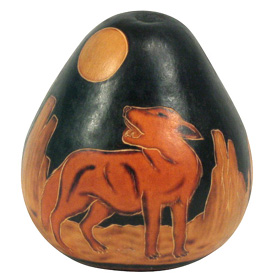 After drying, the artisan draws his/her initial design in pencil, then uses a carving tool to remove small pieces of gourd, creating a 3-dimensional version of the original design. Next, the artisan burns the pattern with a glowing ember, usually a feather-shaped piece of Quinual wood that's been heated over a fire, to establish contrast between the carvings and the gourd. The artisan can vary the intensity of the heat by blowing on the ember; the harder the artist blows, the darker the burn.
Having obtained the color, the artisan washes the gourd to remove
the pencil marks and polishes the finished piece with a natural wax. Sometimes, the artisan applies an oil/charcoal mixture to the gourd's carved surface. The dye adheres any part of the gourd where the outer skin has been removed, yet wipes clean from the gourd's smooth surfaces. This is why some carved gourds have a black background
.

Cochas Chico and Coches Grande, twin farming villages nestled in the Andean mountains of Huancayo Peru, are home to a rich tradition of gourd carving. It's also home to Esperanza Palomino and Raquel Sabastian Rojas, two women who have established small fair-trade businesses to help create new jobs for the artisans in their village. Besides creating new jobs for artisans aged ten to sixty, both women manage work distribution from the main office to give priority to the families with the greatest need.
Esperanza carves her gourds wearing the colorful and traditional Huanca skirts, and its quite common to find her carving surrounded by her husband, sons, brothers, nephews and brothers-in-law. "My biggest dream is that all will have work and that all the families will have a better future," she says.
Raquel's workshop also creates work for about fifteen families and manages orders from the main office. Like Esperanza's workshop, Raquel's artisans share the work so that parents, children and grandparents collaborate together on large orders. "This craft we inherited from our ancestors, grand parents, and parents to the present," Raquel tells us. "Each generation improves the art and it continues to grow with future generations."
"If we have fun in our work, it will teach us to know more of our culture," Esperanza adds. "Through the created drawings we are inspired to do many things. The tradition of gourd carving helps to shape the culture and customs of the town."
About the Artisans
About the Artisans
Chichicastenango, Guatemala, has become one of the most important heritage centers in Guatemala during the past 10 years, due to its predominant indigenous Maya Quiche population and their traditional textile products. Yet, despite increased tourism and a renewed interest in traditional Mayan crafts, work opportunities remain few for the indigenous population, many of whom are uneducated and otherwise unemployable.
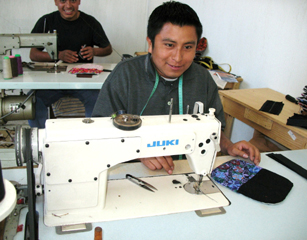 Enter De Colores Art, a local business that levels the playing field for villagers by offering free training to anyone who demonstrates the initiative to learn a trade. The company employs 30 women and 18 men to knit and embroider textile products, with the option of working at home using materials provided by the company. De Colores recognizes the culture of its Mayan employees, and as such allows flexible hours and gives time off for sowing and harvest days.
De Colores also invests in community education projects by funding two local schools in the neighboring towns of Chujupen y Pachoj, and by providing scholarships to qualifying students.
In addition to stimulating the local economy by creating new jobs, De Colores makes a conscious effort to use recycled materials whenever possible. The reason for this is twofold: to preserve Mayan culture, as recycled textiles showcase traditional knitting patterns that aren’t often seen in newer textiles, and to reduce scraps and waste.
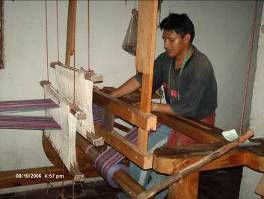
Communities collaborate in the production process, as men work on the biggest textiles and women do the embroidery, crochet and macramé seen in smaller pieces. In some cases, in order to be competitive, sewing machines are used to assemble the finished product, although all the components are handmade and hand embroidered from cotton, wool and/or silk.

