

Low Country Fair Trade
Devil's Trumpet- Night Blooming Moon Flower- Datura Innoxia - Seeds -USA
Devil's Trumpet- Night Blooming Moon Flower- Datura Innoxia - Seeds -USA
Couldn't load pickup availability
Datura Innoxia-Night Blooming
Also known as Devil's Horn, Devil's Trumpet, Moon Flower, and Jimson Weed.
The white and (sometimes) lavender-tinted, trumpet-shaped bloom of the sacred datura promises a wonderous garden of delicate beauty, moths, butterflies, long-tongued bees, hummingbirds, and magical moonlit nights. It gives rise to some of the plant’s other names, for instance, angel’s trumpet, devil's trumpet, moon lily, moon-flower, or belladonna (beautiful lady).
The sacred datura offers a stunning display of white and lavender trumpets, attracting moths, butterflies, bees, and hummingbirds. Also known as angel's trumpet, moon lily, or belladonna (beautiful lady), it promises enchanting moonlit nights in your garden fully opening after dusk. A true beauty with magical powers.
We grow this plant yearly and the seeds are harvested and stored in South Carolina. This plant is an annual and can be grown indoors, although it prefers outdoors in full sun most of the day and does well with some afternoon shade during the hot summer.
"Ingestion of the flowers or any other part of this plant can have dangerous, even fatal, consequences. All parts of the datura plant, also known as Devil's Trumpet or Jimson Weed, are poisonous. The seeds and young leaves of the plant contain the highest amount of toxic alkaloids.
Health officials say that similar or related plants, including Devil's Weed, Devil's trumpet, and Jimson Weed, often are referred to as moonflower and could have similar toxic effects. Within an hour of ingesting the moonflower plant, symptoms begin. Ingesting the plant causes agitation, confusion, and hallucinations.
- Species. See text. Datura is a genus of nine species of poisonous vespertine flowering plants belonging to the family Solanaceae. They are commonly known as daturas, but also known as devil's trumpets, not to be confused with angel's trumpets, its closely related genus Brugmansia.
Datura innoxia is an annual shruby plant that typically reaches a height of 0.6 to 1.5 meters. Its stems and leaves are covered with short and soft grayish hairs, giving the whole plant a grayish appearance. It has elliptical, smooth-edged leaves. All parts of the plant emit a foul odor similar to rancid peanut butter when crushed or bruised, although most people find the fragrance of the flowers to be quite pleasant when they bloom at night.
The flowers are white, trumpet-shaped, 12–19 cm (4.5–7.5 in) long. They first grow upright, and later incline downward. It flowers from early summer until late fall.
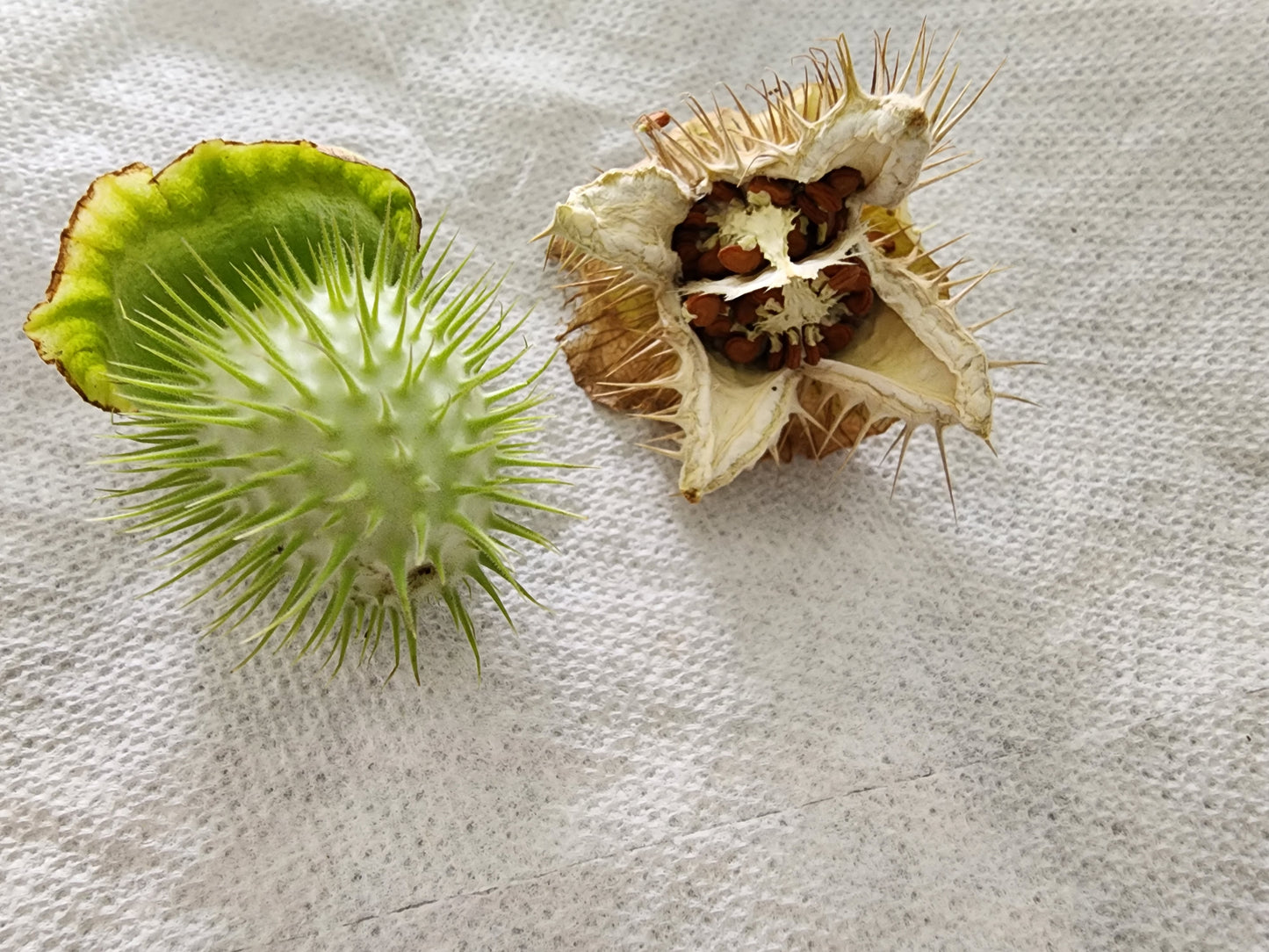
The fruit is an egg-shaped spiny capsule, about 5 cm in diameter. It splits open when ripe, dispersing the seeds. Another means of dispersal is by the fruit spines getting caught in the fur of animals, who then carry the fruit far from the mother plant. The seeds have hibernation capabilities and can last for years in the soil. The seeds, as well as the entirety of this plant act as a deliriant and have a high probability of overdose." Quoted from www.wikipedia.com
About the Artisans
About the Artisans
Chichicastenango, Guatemala, has become one of the most important heritage centers in Guatemala during the past 10 years, due to its predominant indigenous Maya Quiche population and their traditional textile products. Yet, despite increased tourism and a renewed interest in traditional Mayan crafts, work opportunities remain few for the indigenous population, many of whom are uneducated and otherwise unemployable.
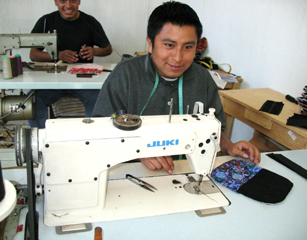 Enter De Colores Art, a local business that levels the playing field for villagers by offering free training to anyone who demonstrates the initiative to learn a trade. The company employs 30 women and 18 men to knit and embroider textile products, with the option of working at home using materials provided by the company. De Colores recognizes the culture of its Mayan employees, and as such allows flexible hours and gives time off for sowing and harvest days.
De Colores also invests in community education projects by funding two local schools in the neighboring towns of Chujupen y Pachoj, and by providing scholarships to qualifying students.
In addition to stimulating the local economy by creating new jobs, De Colores makes a conscious effort to use recycled materials whenever possible. The reason for this is twofold: to preserve Mayan culture, as recycled textiles showcase traditional knitting patterns that aren’t often seen in newer textiles, and to reduce scraps and waste.
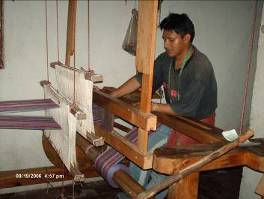
Communities collaborate in the production process, as men work on the biggest textiles and women do the embroidery, crochet and macramé seen in smaller pieces. In some cases, in order to be competitive, sewing machines are used to assemble the finished product, although all the components are handmade and hand embroidered from cotton, wool and/or silk.