

OWP
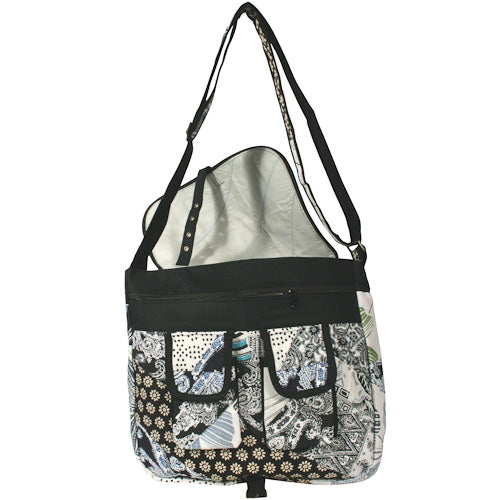
Patchwork Messenger Bag
Patchwork Messenger Bag
Couldn't load pickup availability
Multiple pockets, magnetic button closers and an adjustable strap, these are some of the many features of this recycled messenger bag. These bags are made from re-purposed fabrics. Sorted into like and complimentary colors, the patches are joined together to create these durable and cool bags, perfect for work or school!
These bags are handmade by the youth at Lakshya shelter home in Faridabad, India. Lakshya primarily supports children and youth who have run away from their homes. Lakshya, sends the younger children to local schooling facilities, and the youth are given vocational trainings to help earn a living and support themselves. Buy these unique products and support Lakshya's objective of providing better facilities to these children.
- Measures 13” high x 15-1/4” wide x 3” deep
- Outer flap comes with a buckle closer
- 2 outside pockets and several inside pockets
- 14"-29" adjustable strap
Handmade in India and fair trade imported.
Lakshya, is a child and youth rehabilitation center located in a small village Bhatola, Faridabad, a few miles from Delhi. Lakshya was founded in 2004 by two brothers, Rajeev and Umesh; they started by training a few village women in making newspaper bags. The village women grew from 8 to 150 over the years, and today make newspaper and other paper packaging bags which are supplied to several stores in India.
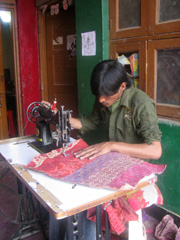 Rajeev and Umesh were part of a larger youth rehabilitaion programe, Karm Marg in New-Delhi. They began their own initiative by the name of “Lakshya”, meaning goal. With the support of the Salam Balak Trust, a well known children and youth rehabilitation center, Lakshya currently runs a center in the village. Many youth and children, who have either runaway from homes or orphaned are found at public places such as railway stations and bus stands. Lakshya's network of people, who closely monitor these locations and keep a regular contact with the local police, bring these youth and children to the shelter. In some cases, parents or relatives are contacted and the children are sent back, in other cases they stay at the shelter for sometime and escape again, while some stay on. Currently, Lakshya supports a mixed group of 25 youth and children in the age group of 7-25 years.
At Lakshya, younger children in the age group of 7-16 years are sent to local schooling facilities. Due to limited funds, the organization has not been able to sponser children for further education. So, the youth learm several vocational skills which will help them to earn a living in the future. 5-6 youth are trained in making patchwork bags and other accessories such as, diary covers, wallets, purses and belts. Other vocational trainings include administrative jobs, cooking & catering, auto mechanics etc. Lakshya sells the handmade bags and other products made by these youth at the shelter through exhibitions and a few stores across India. The organization hopes to rescue and rehabilitate more children and youth who have runaway from their homes, and is constatntly trying to provide them with a more meaningful way to live.
About the Artisans
About the Artisans
Chichicastenango, Guatemala, has become one of the most important heritage centers in Guatemala during the past 10 years, due to its predominant indigenous Maya Quiche population and their traditional textile products. Yet, despite increased tourism and a renewed interest in traditional Mayan crafts, work opportunities remain few for the indigenous population, many of whom are uneducated and otherwise unemployable.
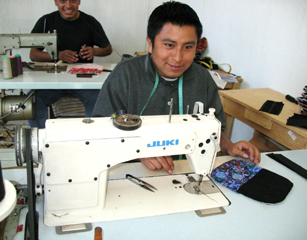 Enter De Colores Art, a local business that levels the playing field for villagers by offering free training to anyone who demonstrates the initiative to learn a trade. The company employs 30 women and 18 men to knit and embroider textile products, with the option of working at home using materials provided by the company. De Colores recognizes the culture of its Mayan employees, and as such allows flexible hours and gives time off for sowing and harvest days.
De Colores also invests in community education projects by funding two local schools in the neighboring towns of Chujupen y Pachoj, and by providing scholarships to qualifying students.
In addition to stimulating the local economy by creating new jobs, De Colores makes a conscious effort to use recycled materials whenever possible. The reason for this is twofold: to preserve Mayan culture, as recycled textiles showcase traditional knitting patterns that aren’t often seen in newer textiles, and to reduce scraps and waste.
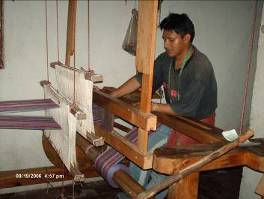
Communities collaborate in the production process, as men work on the biggest textiles and women do the embroidery, crochet and macramé seen in smaller pieces. In some cases, in order to be competitive, sewing machines are used to assemble the finished product, although all the components are handmade and hand embroidered from cotton, wool and/or silk.